
I've written about garnering media attention for your business before, but I keep getting requests to delve a little deeper into the topic. So here you go, this will teach you exactly how to get your online store or a product you're selling featured in the press.
So how do you get the media’s attention?
-
DO check out your target publication’s focus: If it’s a local newspaper, magazine, or website that only covers local companies, focus on that angle. If it’s a national or international publication, look for something that will have broad interest but also has a unique perspective that brings something new to the table. Make it clear why readers in different parts of the country or world would be interested in your story.
-
DO get to know the players: I have to admit, I used to delete emails really quickly when they were addressed “Dear Business Reporter” or “Dear Sir/Madam.” Just as you’re probably not going to pay as much attention to the flyers sent to your house that are addressed to “Occupant,” it makes a huge difference to personalize your pitch. It also helps to do a quick web search on what sorts of topics the journalist covers.
-
DO have several suggested angles: If your first approach doesn’t work, it doesn’t hurt to try a different story angle. The key is to get your awesome story out, even if it’s not the first thing you thought would be interesting.
The Pitches
There are two main types of pitches: The short pitch and the long pitch. Every reporter prefers one or the other. It takes some practice and even a little intuition to figure out which works for certain reporters and publications, but you'll get the hang of it. Generally, send bloggers, and super busy reporters the short pitch. Send larger publications and magazines the long pitch.The Short Pitch
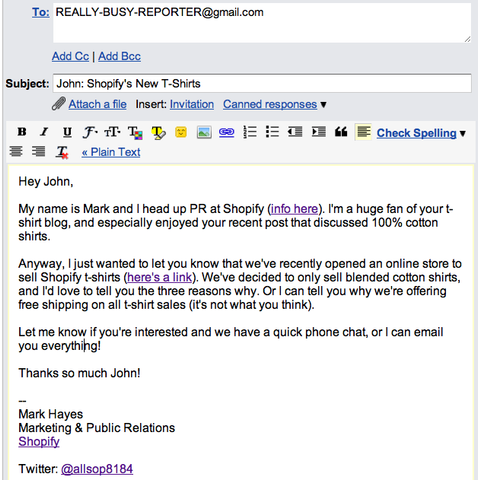
The Long Pitch
DON'T DO THIS
Dear PR: You don't need to send me three reminders in a single day about your event
— Dear PR (@DearPR) October 24, 2011
RT @cbm: @DearPR when you say, "sorry to follow up so soon" are you really?
— Dear PR (@DearPR) August 16, 2011
Dear PR: Please do not send unsolicited high-res images. A lot of IT depts limit inbox size, and this can cause our email to wonk out
— Dear PR (@DearPR) July 11, 2011
Dear PR: Unless you are BFFs with an editor-in-chief, don't send them your press release.
— Dear PR (@DearPR) June 28, 2011
Dear P.R.: I can tell that you cut-and-pasted that "personal" email when my name is one font, and the rest is another
— Dear PR (@DearPR) June 23, 2011
Dear PR: If you've never seen a product on the cover of our magazine, don't ask us to put your product on the cover of our magazine
— Dear PR (@DearPR) June 28, 2011
Dear PR: Your press release is not "High Priority". Please do not flag it as such.
— Dear PR (@DearPR) June 29, 2011
Dear PR: Blocking your caller ID doesn't make us want to pick up any more
— Dear PR (@DearPR) September8, 2011
RT @cbm: . @DearPR When you send me a note that says "THIRD ATTEMPT" that's not a good look.
— Dear PR (@DearPR) September 19, 2011
Also... Don't Do These
-
DON’T exaggerate: Even if you genuinely believe your new gadget or app will be the greatest innovation since sliced bread, don’t overuse words like “breakthrough” or “revolutionary” in your pitch. Instead, get specific with reasons why people will be interested in your product (e.g. it’ll make doing something easier/faster/cheaper).
At the same time, don’t get bogged down with too many minute, jargon-y details – even if you’re pitching a highly technical publication (and this is where it helps to understand your target’s editorial focus), it’s not that likely that the nitty-gritty will be what grabs their attention first.
-
DON’T give up: While you don’t want to get to the point of being annoying or pushy, reporters have been known to take a second look at a story if you’re politely and pleasantly persistent. This goes back to the points about preparing several angles for a publication, as well as getting to know the players, since you’re establishing contact with your emails, calls, or Twitter messages. However, it helps to make sure you’re offering something new and timely each time you contact a reporter; if you’re pitching the same old story again and again and the media outlet has already told you it’s not interested, you’ll likely be wasting your time.
- DON’T disappear: So you’ve got someone’s attention and they’ve agreed to cover your story. Great! Now is NOT the time to turn off your smartphone or consider your pitching job done. It’s particularly irritating for a journalist who’s received a pitch to suddenly find themselves up the creek at deadline because their contact at the company is nowhere to be found. Even if last-minute issues come up, it definitely helps to keep the reporter informed – it establishes a good relationship and you might still be able to arrange another interview at a more convenient time.
To Conclude
Okay, so after reading all that and having a laugh at some of those funny Tweets, I want to leave you with the PR industries response to Dear PR. It's called Dear Journalist and it's a hilarious collection of complaints against the community of journalists - as told from the PR industry. Always remember... there's two sides to every story. Good luck making headlines. :-)Oh yes that's right, I am psychic and know you are on deadline and just calling to piss you off. My bad.
— DearJournalist (@DearJournalist) October 18, 2011
Topics:
Join 446,005 entrepreneurs who already have a head start.
Get free online marketing tips and resources delivered directly to your inbox.
Thanks for subscribing
You’ll start receiving free tips and resources soon. In the meantime, start building your store with a free 14-day trial of Shopify.


